30 ‘Made in Bangladesh’ Outlets to be Opened in Various Chinese Cities
Tuesday, August 25, 2026
Bangladesh is well known around the world for producing quality garments. However, despite this reputation, the country has so far failed to establish a brand under the name “Made in Bangladesh,” which is a major weakness for the country’s apparel sector. Bangladeshi entrepreneurs have also shown limited interest in exporting products to the Chinese market. Foreign buyers, fearing that they could lose their market share in China, are also reluctant to see Bangladesh directly export garments to the Chinese market.
Bangladeshi garment owners are similarly concerned about losing international buyers. Gas and electricity shortages are having a negative impact on business and trade in the country, while Chinese and other foreign investment has not been coming in. At the same time, the nature of extortion in the country has changed. Instead of directly demanding money, some people obtain trade licenses and say, “I am also a businessman, give me business.”
These issues were discussed in an exclusive interview with Jago News by Mohammad Khorhed Alam, President of the Bangladesh-China Chamber of Commerce & Industry (BCCCI) and a director of the Bangladesh Textile Mills Association (BTMA).
Bangladesh-China Business Relations
Jago News: How do you view the current business relationship between China and Bangladesh?
Khorhed Alam: The business relationship between Bangladesh and China is very old. However, our biggest problem is the trade deficit. Last year, Bangladesh imported approximately US$17 billion worth of products from China, while our exports to China amounted to only around US$690–700 million. This is an extremely large gap.
One reason is that Chinese products are competitively priced, have good quality, and are supported by advanced technology. Whether in machinery, textiles or electronics, China is competitive in international markets. This has enabled China to establish markets not only in Bangladesh but in many countries around the world.
Why Is Bangladesh Unable to Enter the Chinese Market?
China has provided Bangladesh with duty-free access for more than 100 products and is interested in purchasing Bangladeshi goods. However, Bangladeshi entrepreneurs have limited interest.
We often talk about our garment industry, but we do not have an international brand of our own. We have failed to establish a brand called “Made in Bangladesh.” Foreign buyers manufacture garments in Bangladesh and sell them in the Chinese market under their own brands. They take the profits.
Bangladesh’s garment industry has been known internationally for more than 40 years. Everyone knows that Bangladesh produces good-quality garments. But the lack of our own brand remains a major weakness.
He also expressed concern about the misuse of trade licenses to legitimize extortion, saying that some people obtain a trade license for only 200 taka and then identify themselves as businessmen to demand business opportunities. He warned that unless the government genuinely controls such activities, the country’s industries will face serious difficulties in surviving.
New Initiative to Enter the Chinese Market
A major exhibition will be held in Kunming, China, from 11 to 16 June. China is providing Bangladesh with free stalls and has offered to transport Bangladeshi products from the airport to warehouses at its own expense.
However, interest among Bangladeshi entrepreneurs is very low. He had requested 20 stalls, which were provided, but only nine entrepreneurs showed interest in participating. He believes many entrepreneurs fear that if they sell directly in China, their existing foreign buyers may stop purchasing their products.
What Gives China Its Competitive Advantage?
China is a country capable of manufacturing almost everything, from needles to fighter aircraft. It has the ability to produce a wide range of products domestically. Its main strength is its ability to offer good-quality products at low prices.
This is why China has captured markets around the world. If Bangladesh can offer products at competitive prices while maintaining good quality, it too can gain access to international markets.
Prospects for Chinese Investment in Bangladesh
China certainly wants to invest in Bangladesh, particularly in the textile and other industrial sectors. However, Chinese investors first want to know whether there is a reliable supply of gas and electricity.
According to Khorhed Alam, one Chinese investor has reportedly been waiting for six years after acquiring industrial land but has still not received a gas connection. He questioned why foreign investors would come under such circumstances.
China had planned to invest around US$7 billion in Bangladesh’s textile sector, but the plan has currently been suspended because of uncertainty over gas and electricity supplies.
Another major obstacle is the shortage of skilled manpower. Bangladesh still lacks enough technicians, skilled workers and managers capable of operating modern Chinese machinery. Therefore, Chinese investors are looking at two key issues: energy security and skilled manpower.
Current Business Environment
According to Khorhed Alam, profit and loss are normal parts of business, but people are currently operating under considerable fear. Businesspeople are worried about what might happen to them. Several Chinese businessmen have also complained to BCCCI that they are facing pressure from different groups and are uncertain whether they will be able to continue operating their industries in Bangladesh.
He said that, based on the information available to him, extortion has increased further. Complaints to the police have not produced results, and several groups within the same political organization are allegedly involved in such activities. He warned that unless the government takes effective action, this could become a major threat to industries and make it difficult for them to survive.
Future Plans of BCCCI
BCCCI is working on several major initiatives. First, it plans to pursue the establishment of a Chinese commercial bank in Bangladesh. Second, it wants to attract Chinese investment into Bangladesh’s capital market.
Third, it plans to establish 30 “Made in Bangladesh” outlets in different cities across China. These outlets would sell a wide range of Bangladeshi products, including garments, agricultural products, ceramics, medicines and dairy products.
Prospects for “Made in Bangladesh” Outlets
Khorhed Alam described the initiative as a long-term plan, acknowledging that there are obstacles. Some international businessmen do not want Bangladesh to enter the Chinese market directly because this could reduce their profits.
Nevertheless, BCCCI is continuing its efforts. He believes that if Bangladesh can enter the Chinese market directly, it will create major opportunities for the country.
Developing Skilled Manpower
Khorhed Alam said he has proposed to the Chinese government that 20 polytechnic institutes be established in Bangladesh.
China places strong emphasis on technical education and provides practical skills training. Chinese expertise could help train Bangladeshi young people in areas such as fish farming, automobile parts manufacturing and modern technology.
Message on the Chinese Market
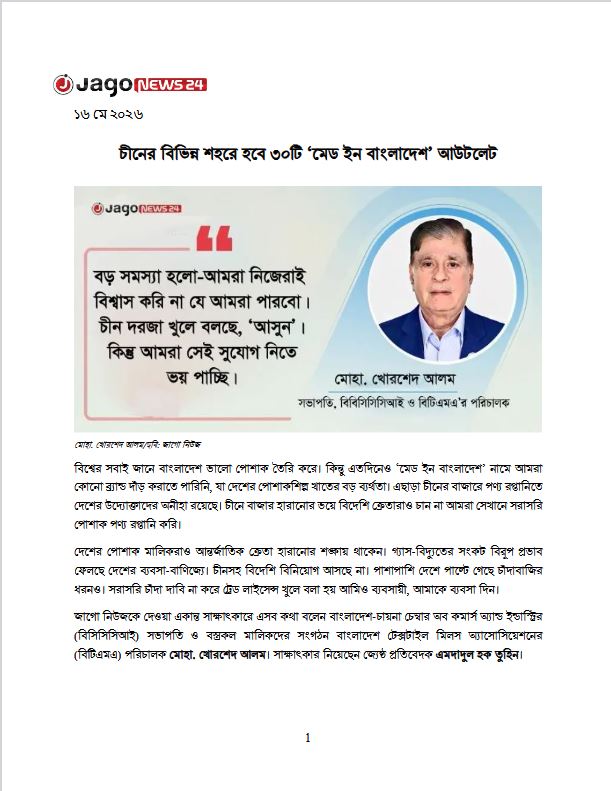
Khorhed Alam said Bangladesh’s biggest problem is that Bangladeshis themselves do not believe they can succeed.
China has opened its doors and is saying, “Come.” But Bangladesh is afraid to take advantage of the opportunity. He believes this is the right time to strongly promote the “Made in Bangladesh” brand in the global market.
Programs / Events

News