China Wants a Concrete Action Plan for the Prime Minister’s Visit
Tuesday, August 25, 2026
China has launched visible diplomatic efforts to quickly and further deepen Bangladesh’s involvement in the much-discussed Belt and Road Initiative (BRI). Prime Minister Tarique Rahman’s visit to Beijing is scheduled for this month, and China is moving forward with the aim of signing a comprehensive cooperation plan during the visit.
China’s National Development and Reform Commission (NDRC) has already sent a detailed draft proposal to Dhaka through the Bangladesh Embassy. The proposal has urged an early decision on the matter. Diplomatic sources said China has directly contacted Bangladesh to finalize the plan quickly. After Bangladesh raised objections to some provisions of the first version of the draft, a revised version was sent, reflecting Beijing’s high-level attention and interest in the issue.
Sources said China wants to present the plan as a major diplomatic outcome of the Prime Minister’s visit.
The proposed cooperation plan has been prepared as a continuation of the 2016 BRI-related MoU signed during Chinese President Xi Jinping’s visit to Bangladesh. However, its scope and depth are considerably broader than previous initiatives. Although it is a non-legally binding policy document, the proposals included in it could form the basis for major economic agreements in the future.
23 Areas of Cooperation
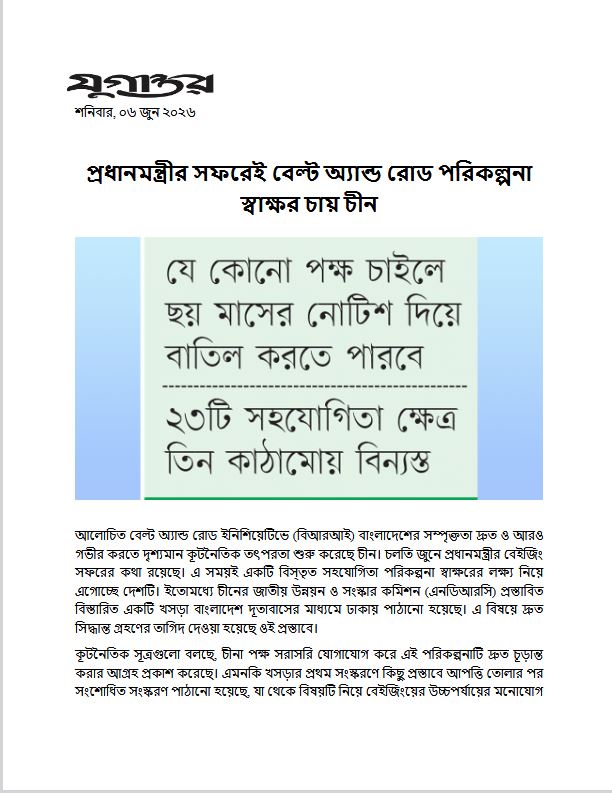
The draft contains 23 areas of cooperation, organized under three frameworks: cooperation platforms, cooperation mechanisms, and supporting policies.
The areas cover a wide range of sectors, including economic policy, trade, investment, energy, digital economy, green development, agriculture, science and technology, education, healthcare, maritime cooperation, infrastructure, and disaster management.
As part of the cooperation platform, Bangladesh has been encouraged to participate actively in China’s major international trade fairs and exhibitions, including the China International Import Expo, China Import and Export Fair, and China-South Asia Expo.
Other proposed initiatives include regularly organizing international cross-border e-commerce forums, operating Chinese-language education forums in Bangladesh, maintaining regular exchanges between think tanks and researchers, and holding maritime cooperation dialogues. Regular meetings of the China-Bangladesh Joint Economic and Trade Commission have also been emphasized.
Permanent Coordination Framework Proposed
Under the cooperation mechanism, the draft proposes establishing a permanent high-level coordination structure between the two countries to ensure rapid progress at the implementation stage.
It also proposes forming a joint working group on the digital economy, cooperation in cloud computing, and a separate coordination mechanism to reduce carbon emissions. In agriculture, cooperation would include the development of hybrid rice and wheat, technology exchanges, and joint research.
Free Trade Agreement and Currency Swap
The most significant section of the draft is its supporting policies, which contain several major economic and financial initiatives that could potentially reshape the economic relationship between the two countries.
These include starting negotiations quickly on a China-Bangladesh Free Trade Agreement (FTA), updating the existing investment agreement, introducing a currency swap arrangement, strengthening banking and financial cooperation, and increasing the use of local currencies in bilateral trade.
The draft also proposes expanding banking operations in both countries and deepening cooperation in infrastructure and engineering.
Duration and Legal Status
According to the draft, the plan would remain effective indefinitely after signing, but it would not create any legal obligation. Either party could withdraw by giving six months’ notice.
The draft also calls for confidentiality in information sharing and says that any disputes should be resolved through mutual consultation.
Strategic Message from Beijing
Diplomatic analysts believe China’s initiative to finalize and sign the draft before the Prime Minister’s visit carries a clear strategic message. It indicates that Beijing is actively working to deepen Bangladesh’s engagement under the BRI framework.
However, some stakeholders believe that provisions involving free trade, currency swaps, and banking expansion could create concerns about long-term economic dependence. They therefore believe these issues require detailed review before final decisions are made.
Programs / Events

News