Investment will be Given Priority The Prime Minister’s Visits to Malaysia and China
Tuesday, August 25, 2026
Investment Will Get Priority: Prime Minister’s Malaysia and China Visits
Dhaka, Saturday, 20 June 2026
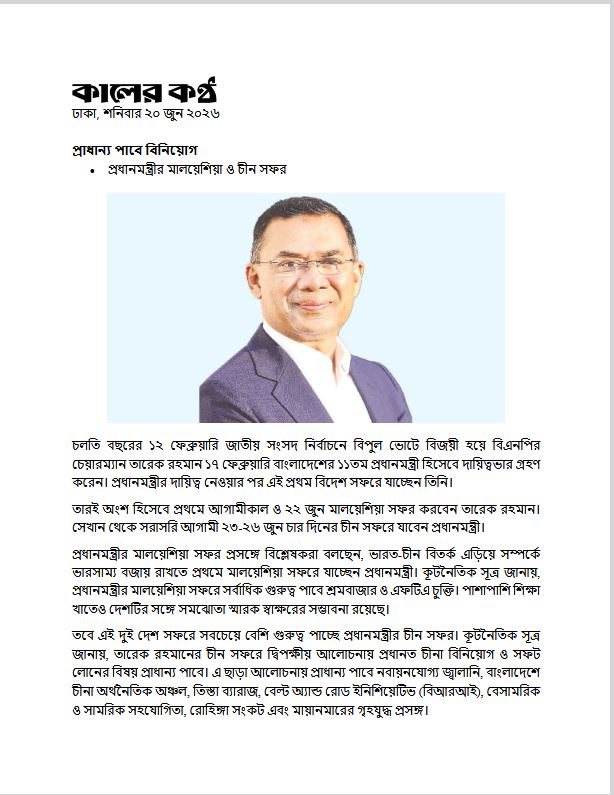
After winning the national parliamentary election held on 12 February with a large majority, BNP Chairman Tarique Rahman took office as Bangladesh’s 11th Prime Minister on 17 February. He is now undertaking his first foreign visits since assuming office.
As part of this, Tarique Rahman will first visit Malaysia on 21 and 22 June. From there, he will travel directly to China for a four-day visit from 23 to 26 June.
Analysts say the Prime Minister is visiting Malaysia first in order to maintain a balanced relationship between India and China while avoiding disputes between the two countries. Diplomatic sources said the labour market and a Free Trade Agreement (FTA) will receive the greatest priority during his Malaysia visit. There is also a possibility of signing a MoU in the education sector.
However, the Prime Minister’s China visit is attracting the greatest attention. Diplomatic sources said that during bilateral discussions in China, Chinese investment and soft loans will receive priority. Other key issues will include renewable energy, a Chinese economic zone in Bangladesh, the Teesta Barrage, the Belt and Road Initiative (BRI), civilian and military cooperation, the Rohingya crisis, and the civil war in Myanmar.
14–16 MoUs in Preparation
According to diplomatic sources, preparations are underway to sign 14 to 16 Memorandums of Understanding (MoUs) during the Prime Minister’s China visit. Drafts of these agreements are currently at the finalization stage.
As part of the visit, a high-level investment conference titled “Invest in Bangladesh” will be held in Beijing on 25 June. The main objective of the conference will be to attract Chinese investors and highlight Bangladesh’s investment opportunities. Prime Minister Tarique Rahman is expected to attend the event.
Another important context of the China visit is the Belt and Road Initiative (BRI). During Chinese President Xi Jinping’s visit to Bangladesh in 2016, agreements were signed for around 21 projects under the initiative. During the upcoming visit, some of those previous agreements may be updated and reassessed, while new decisions may be taken in line with changing global circumstances.
The Prime Minister is travelling to China with the objective of taking Dhaka-Beijing relations to a new level. His delegation is expected to include Foreign Minister Dr. Khalilur Rahman, Finance Minister Amir Khasru Mahmud Chowdhury, Prime Minister’s Foreign Affairs Adviser Humayun Kabir, and Foreign Secretary Asad Alam Siam.
China Is Bangladesh’s Largest Trading Partner
International relations analysts believe the Prime Minister’s China visit will strengthen understanding, relations and partnership between the two countries and signal new commitments toward advancing strategic cooperation.
During his Beijing visit, Tarique Rahman is expected to meet Chinese President Xi Jinping and various stakeholders to discuss political, strategic, economic and cultural issues.
Parvez Karim Abbas, Executive Director of the Centre for Governance Studies (CGS) and an assistant professor at East West University, told Kaler Kantho that one of the most important issues during the visit will be export markets and the challenges Bangladesh will face after graduating from the LDC category.
He said China is currently Bangladesh’s largest trading partner, accounting for approximately 25 percent of Bangladesh’s imports. Bangladesh is particularly dependent on China for importing raw materials, fabrics, machinery and technology for the ready-made garment industry. Bangladesh also has long-standing cooperation with China in defence equipment and various industrial products.
He further said the current global environment is going through a complex geopolitical transformation involving China-US technological competition, India-China strategic rivalry and cooperation, and closer US-India relations.
In this situation, the most realistic strategy for Bangladesh is to maintain multilateral and balanced foreign economic relations rather than becoming dependent on any single power.
Potential for Chinese Investment
Abu Taher, Executive Director of the Bangladesh China Chamber of Commerce & Industry (BCCCI), said Bangladeshi businessmen have already held preliminary discussions with several major Chinese companies about investment in Bangladesh.
He said opportunities are emerging to attract investment in various sectors. Although the process is still at an early stage, there is potential for substantial investment in the future. Government-level policy and diplomatic decisions are currently being determined, meaning investment and implementation remain dependent on policy and diplomatic discussions.
China’s Loans to Bangladesh
At present, the World Bank, Asian Development Bank (ADB) and Japan are ahead of China in terms of loan disbursement.
According to Economic Relations Division (ERD) data, up to FY 2024–25, Bangladesh had received approximately US$200 billion in total foreign commitments, of which around US$140 billion had been disbursed. Of the disbursed amount, approximately US$30 billion came as grants and US$110 billion as loans.
Programs / Events

News